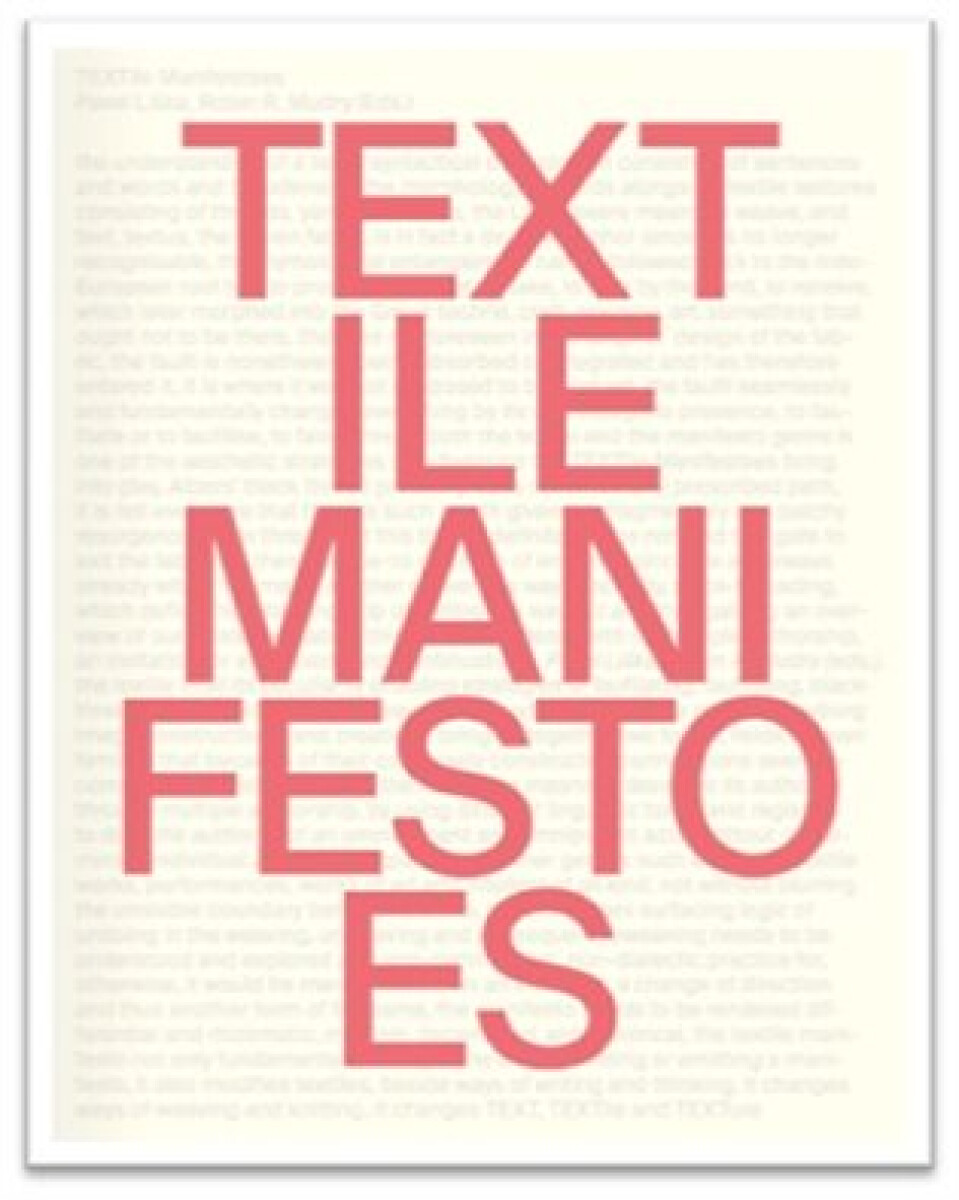
TEXTile Manifestoes


TEXTile Manifestoes je mezioborová antologie, která spřádá
nejrůznější otázky spojené s textilním uměním, módou, textualitou a
vetkává je do širších politických, sociologických, filosofických a
umělecko-historických souvislostí, čímž překračuje rámec jejich
vlastní textury. Propojením…
Annotation in English:
The TEXTile Manifestoes is an interdisciplinary anthology that
assembles and interweaves questions related to textile art, fashion
and textuality into broader political, sociological, philosophical,
art history and historical frameworks thereby expanding their range
of textural interconnections. This anthology departs from the
genre-related ambivalence of the manifesto as a modern male form of
authoritatively demanding radically different futures by using the
manifesto to connect with the triadic complex of TEXT - TEXTile -
TEXTure in order to reflect, refashion and redefine it in creative,
critical, deconstructive and decolonial ways. Departing from the
structural and metaphorical contiguity of texts and textiles,
TEXTile Manifestoes aims to rethink the political and ethical in a
world desperately seeking the certainties and clear programmes of
modern manifestoes without returning to the worst forms of
historical totality. The original project "TEXTile Manifestoes”
emerged out of a cross-disciplinary collaboration between several
studios at the Academy of Arts, Architecture and Design in Prague.
Students from the Studios of Fashion and Footwear Design, Graphic
Design, Visual Communication and Type Design as well as Photography
II worked together to weave textiles and discourses alike to design
their manifestoes by combining fashion collections with burning
contemporary issues such as mass surveillance, artifical
intelligence or virtual reality but also to more private struggles
of identity, memory and (mental) health. The students' works were
later complemented by and (re)contextualised with international
contributions ranging from ancient Andean textile studies to
neuropsychoanalysis or from literary and art criticism to
aesthetics and musicology. With texts by Kyle Allan, Jayson
Althofer, Erik Annerborn, Luciana Benetti Marques Valio, Shelley
Burian, Subhradeep Chatterjee, Ingrid Cogne, Arthur Crucq, Evelyn
Echle, Pasquale Fameli, Tereza Jiroutová Kynčlová, Paris Lavidis,
Elisabeth Längle, Pavel Liška, Veronica Montanino, Robin R. Mudry,
Pierluca Nardoni, Anna Maria Panzera, Anika Reineke, I. A.
Roland-Rodríguez and Anne Röhl.